A competitor can rebuild a product close to yours faster than it has ever been possible. Your pipeline still has to come from somewhere, and that somewhere is now the part of the business they cannot ship.
This year's State of B2B GTM report put a number on it. Kyle Poyar and Maja Voje surveyed 300 software and AI companies in September 2026.
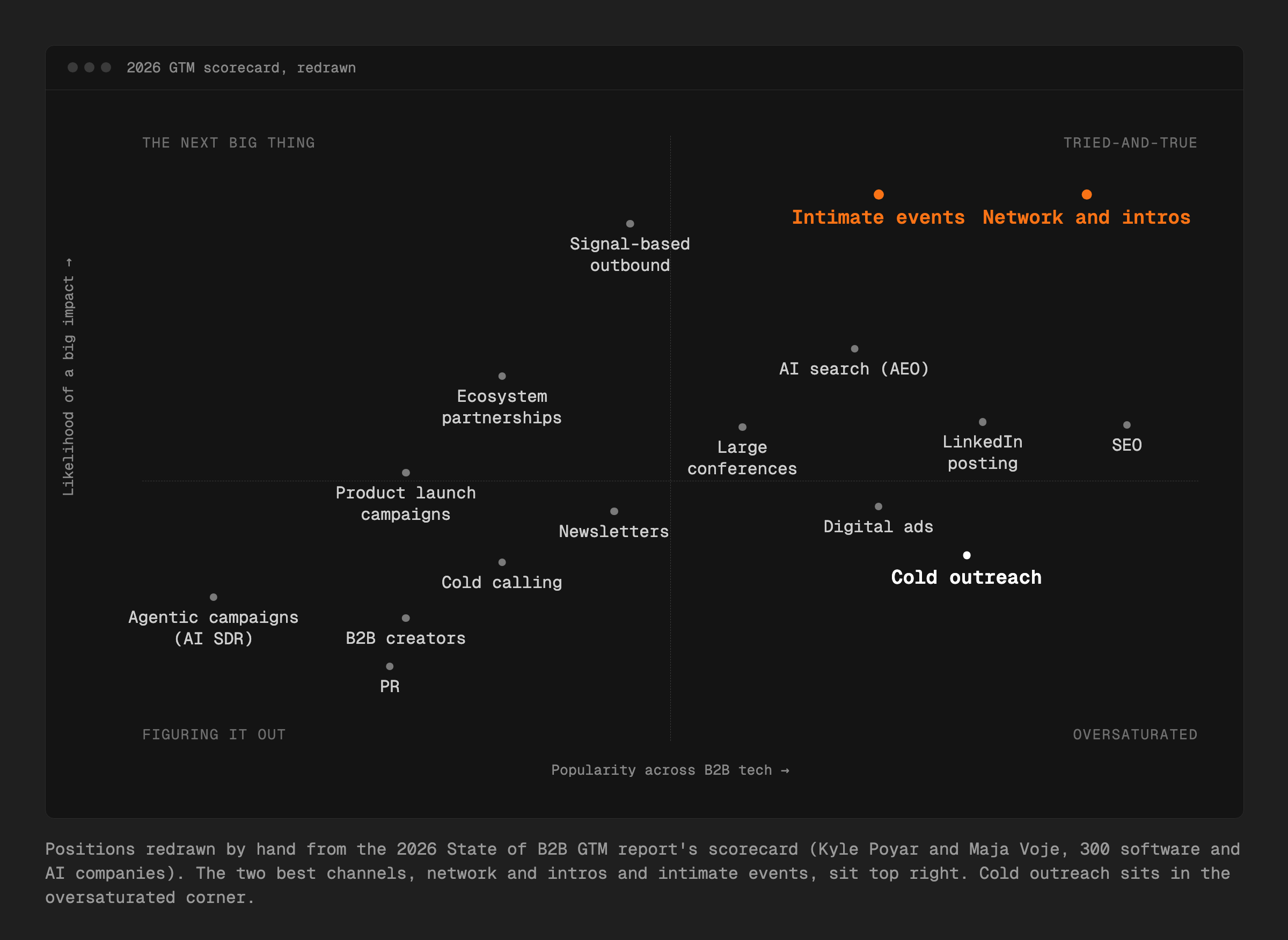
The two channels rated best on its scorecard were network and intros, then intimate events. Kyle called them "decidedly anti-AI."
That finding is the subject of this piece. Why the channels nobody can produce are winning, where that stops being true, the six ways teams get it wrong, and a 30-minute test you can run on your own channels this week.
Why are the best channels the ones AI cannot produce?
Look at what a team can switch on with money and tools in a month. Paid ads, cold outreach, AI SDR sequences, content at volume. Every competitor with a budget has the same access, so every competitor is in the same inbox and the same feed.
The report's scorecard sorts channels by how popular they are and how well they work. Cold outreach is core for 46% of companies. It landed in the oversaturated corner.
Kyle's takeaway was blunt. "Cold outreach is officially oversaturated, and AI SDRs aren't living up to the early hype."
Now look at what nobody can switch on in a month. A network that answers when you ask for an intro. A room of twenty buyers who came because they know the host. A founder whose posts people have read for a year.
Each one is built a conversation at a time. A competitor starting today starts at zero.
That is where the adoption numbers sit too.
Core channel, share of 300 companies (2026 State of B2B GTM)
Network and intros                  62%   the highest of any channel
SEO                                 51%
LinkedIn posting (founders, staff)  50%
Cold outreach (email, LinkedIn)     46%
Intimate events                     40%
AI search (AEO)                     39%
Paid digital ads                    38%
Agentic campaigns (AI SDR)           7%
My read is that the moat moved to what can't be produced. A product can be rebuilt. A network and an audience have to be earned.
Where does this stop being true?
The finding has a shape, and the shape matters more than the headline.
It is strongest where deals are big and companies are young. Among companies selling above $50K a year, 51% put network and intros in their top three channels and 42% put intimate events there.
Under $1M in revenue, 54% name network and intros. Founder-led sales is the most common sales motion in the whole survey, and 44% of companies under $1M lead with it.
It weakens where deals are small and companies are large. Under $5K a year, paid ads are the most named top channel, at 42%. Above $50M in revenue, paid ads are first again, at 43%.
A product that sells itself for a few hundred dollars a month can buy its way to customers. A five-figure system that changes how a team works mostly can't.
And it does not last on its own. Kyle's own caution on founder-led sales is that "growth is likely to slow without a more repeatable GTM." An earned channel compounds, and it also has a ceiling, which is the founder's hours.
So the honest version of the claim is narrower than the slogan.
If your deals are mid-sized or larger and you're still early, the channels a competitor can't copy are where your pipeline most likely comes from. That's where the effort goes first.
What do teams get wrong when they act on this?
The report printed a page of what didn't work, in the respondents' own words. Most of the mistakes below are on it.
1. Scaling a produced channel to make up the volume. The reflex when pipeline is short is more sends. One respondent ran "Agentic outbound (AI SDR) sequences. High volume, near-zero reply rate, and it hurt our sending reputation." Another listed "Mass AI-created content across email and InMail (LinkedIn)." Volume in a saturated channel buys a worse reputation in that channel.
2. Buying reach that only looks earned. An audience someone else built is still someone else's. One respondent paid "a tier 1 influencer $24k for a 3 month deal" and put it on the didn't-work list. B2B creators are core for 12% of companies. Rented trust ends when the contract does.
3. Skipping the earned part entirely. "Trying to go to US without any brand awareness, without any investment in brand, was a horrible GTM decision." A market that has never heard of you has no network to ask and no room to fill.
I made a version of this one myself. I spent a long stretch trying to keep myself out of demand gen and let the system carry it. It's what every founder does from zero to one. Posting every day came out of accepting that.
4. Measuring the earned channel at the top. Followers and impressions are how a posting habit looks from outside. The number that pays is conversations. I judge a channel on first calls booked and read reach as an early sign on the way there, because a post that gets seen and starts nothing has only produced a vanity metric.
5. Quitting before it compounds. A network channel looks like nothing for months. The earned channels reward the team that is still showing up in month nine.
6. Treating "anti-AI" as "no AI." What the buyer gets from these channels is a person they trust. The work behind that person is a different question.
Finding which accounts already know someone on your team, building the dinner list, drafting the follow-up after the intro. A system can do all of it, so the founder spends their hours in the conversation itself.
How do you find which of your channels a competitor could copy?
This is the test. It takes about 30 minutes and a list of where your last 90 days of first conversations came from.
If your CRM has a source field, start there. If it doesn't, the founder's memory of the last twenty first calls is good enough.
Step 1. List every channel that produced a first conversation. Only the ones that put a buyer in a call. Spend doesn't get you on the list.
Step 2. Count the conversations. Next to each channel, the number of first conversations in 90 days. This is the outcome, so it comes before anything about reach or spend.
Step 3. Ask the copy question. For each channel, could a competitor with the same tools and a budget produce this next month? Mark it COPYABLE or EARNED. Paid ads, cold sequences and bought lists are copyable. Intros from your network, events where buyers came for the host, a posting history people follow, and partners who refer you are earned.
Step 4. Put your effort next to it. Roughly what share of last quarter's hours and spend went to each channel.
Channel                     First convos (90d)   Copy test   Share of effort
Intros from network                  9           EARNED          10%
Founder posts on LinkedIn            4           EARNED          15%
Cold sequences                       3           COPYABLE        45%
Paid ads                             1           COPYABLE        30%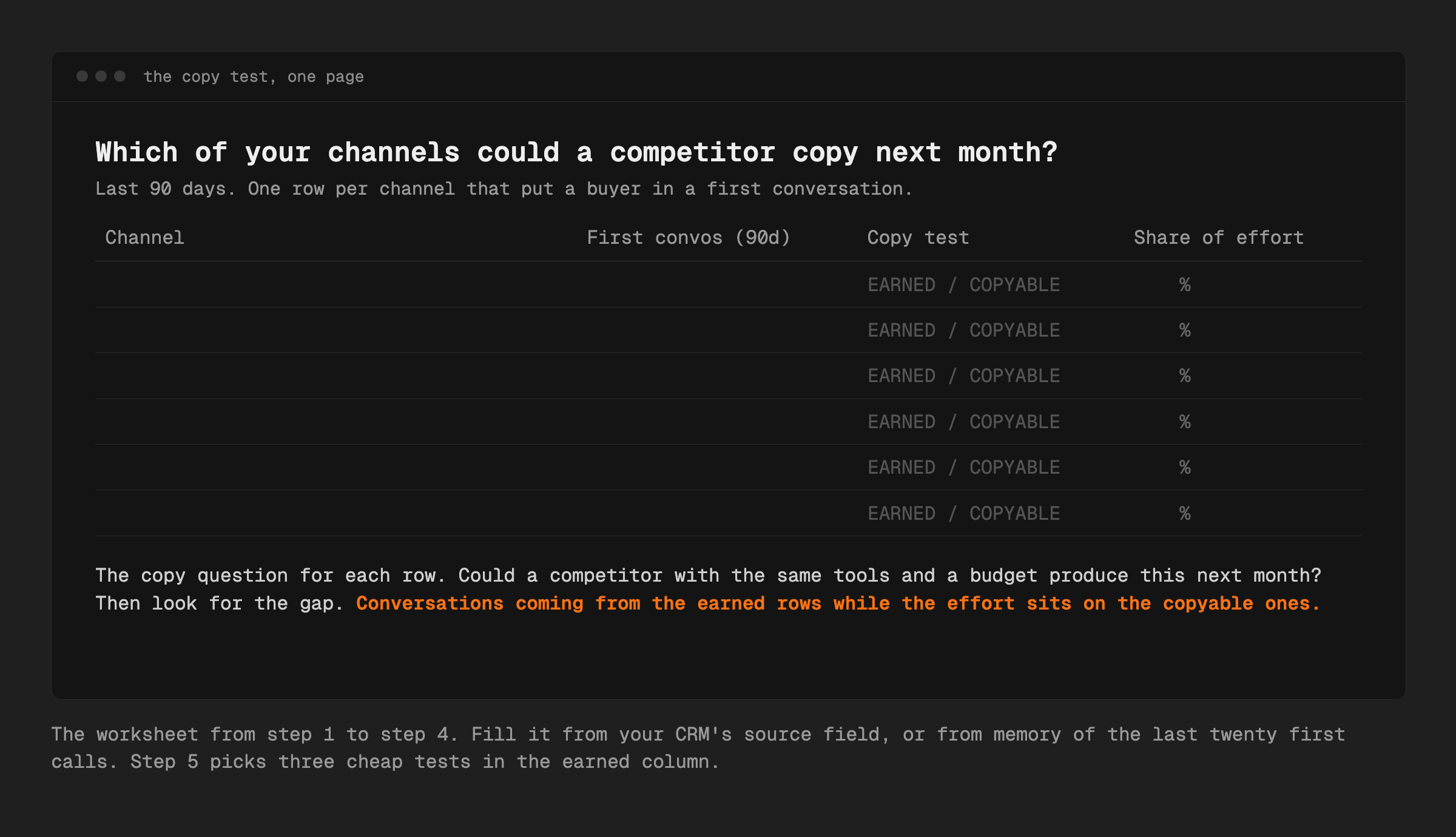
The numbers above are invented to show the shape. The pattern to look for is the gap, a column of conversations coming from the earned rows while the effort sits on the copyable ones.
Step 5. Pick three cheap tests in the earned column. This is the Bullseye method from Weinberg and Mares's Traction, applied to one column. Brainstorm every earned channel you could run, rank them, and pick the three most promising. Test the three at the same time, cheaply, for one quarter. A test answers three questions. What does a conversation cost here, how many conversations does this channel hold, and are they the buyers you want? Then put the effort into the one that works, and run the test again when it stops growing.
Step 6. Keep one copyable channel running and stop feeding it extra volume. The scale argument above is real. A copyable channel can still pay, especially at small deal sizes. What the test changes is where the next hour goes.
So before adding another automated channel, count last week. How many conversations came from your network and intros, and how many posts went out under your name?
What this does not establish
The report is a self-reported survey of 300 companies. The most common respondent was $1M to $10M in revenue (35%) with deals between $5K and $50K (49%).
"Core channel" means the respondent called it core, and the scorecard rates channels by respondents' own sense of what works. That's a good read on where teams put their trust. It measures no channel's return.
Nothing here says which channel will work for you. The copy test sorts your channels by what a competitor could take. Your own conversation counts decide where the effort goes.
FAQ
Does this mean I should stop outbound? No. Cold outreach is still core for 46% of companies.
It's in the top three for a third of teams selling $5K to $50K deals, and for 41% of companies under $1M. The test asks you to stop adding volume to a channel everyone can copy before the earned channels have had their quarter.
What counts as an earned channel? One a competitor can't switch on with money in a month. Intros from your network, events where buyers came because of the host, a posting history people follow, partners who send you deals.
If you could buy more of it next month, it's copyable.
Is the founder the only person who can run the earned channels? Early on, mostly yes. And 44% of companies under $1M lead with founder-led sales.
The report's own caution is that growth slows without a more repeatable motion. The second step is getting the team's network and posting into the same column.
Where does AI fit if the best channels are anti-AI? Around the conversation. Finding the warm path into an account, building the guest list, drafting the follow-up. The buyer still meets a person they have reason to trust.
How long before an earned channel shows up in the numbers? Longer than a copyable one. That's why teams quit too early. Run the three tests for a full quarter before judging them, and judge them on conversations.
Your turn
Look at where your last ten first conversations came from. How many came through a channel a well-funded competitor could switch on next month?